
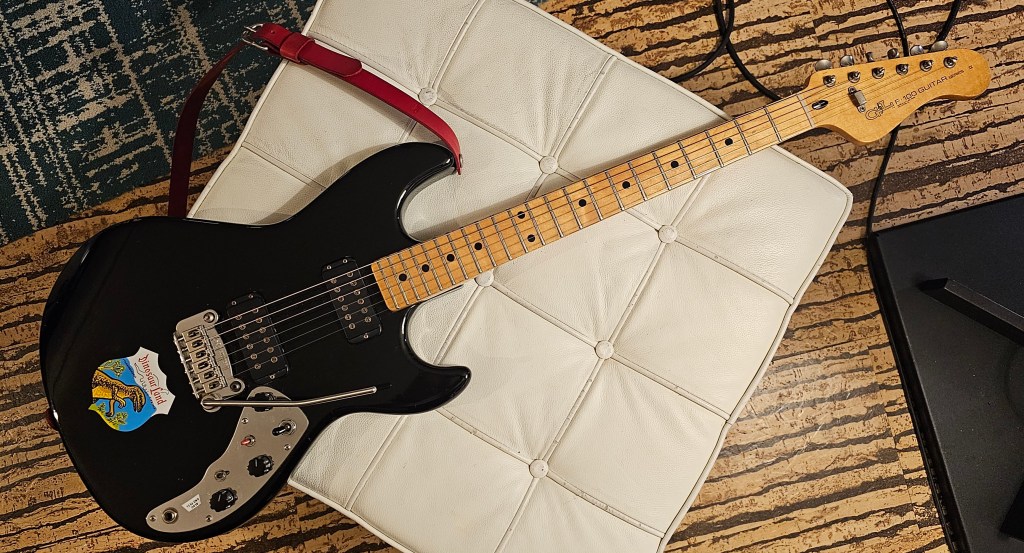
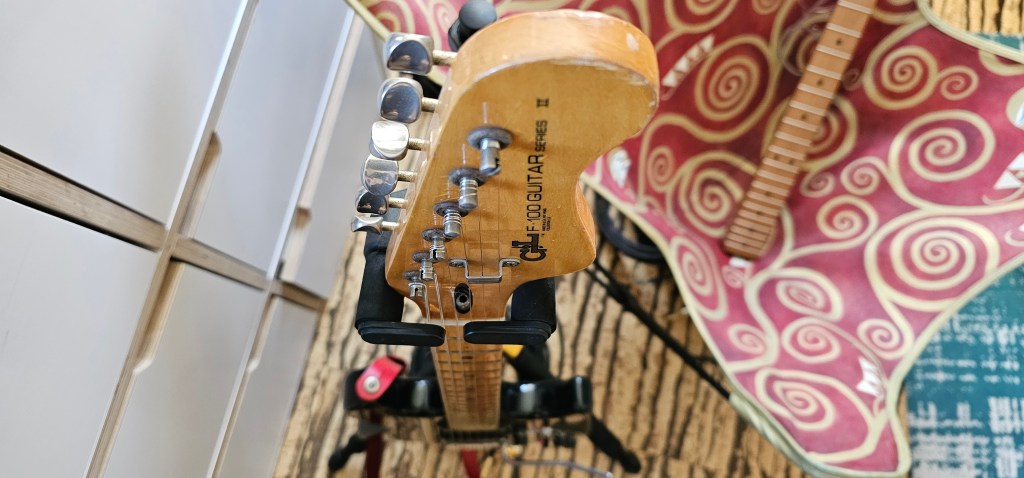
This is early enough in the first run (about 2,130 guitars in, from what I’ve been able to pick up) to still have the original headstock design. I like it better.
It doesn’t have the panache of the one Leo swiped from Paul Bigsby, but it was close enough that Fender came after their founder, and it was soon replaced by the not-as-cool-as-the-Epi-batwing version that has endured.
Leo took what he learned from the strat trem and the dynamic vibrato on the Mustang and married those ideas to great effect to come up with the dual fulcrum vibrato he brought with him to G&L. He’d been away from guitar design for a decade or more while he worked on Music Man. It’s a great design. 2 heavy springs! Mine has a third in the center that isn’t as heavy. I assume it was added, but I’d be grateful to learn more. I’ve never been sure how much the third spring contributes, but the vibrato is lovely, so it has stayed
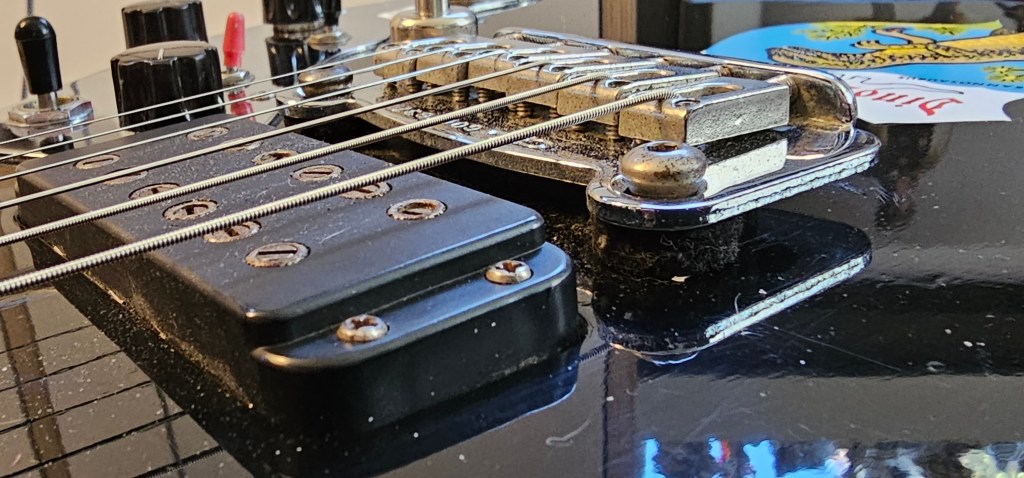
The design is at once rock solid and super fluid. The construction details are well thought out and uncompromisingly executed. There’s a willingness to spend for results. The collet is clunky looking but absolutely secure. The saddles are machined steel rather than cast or bent.
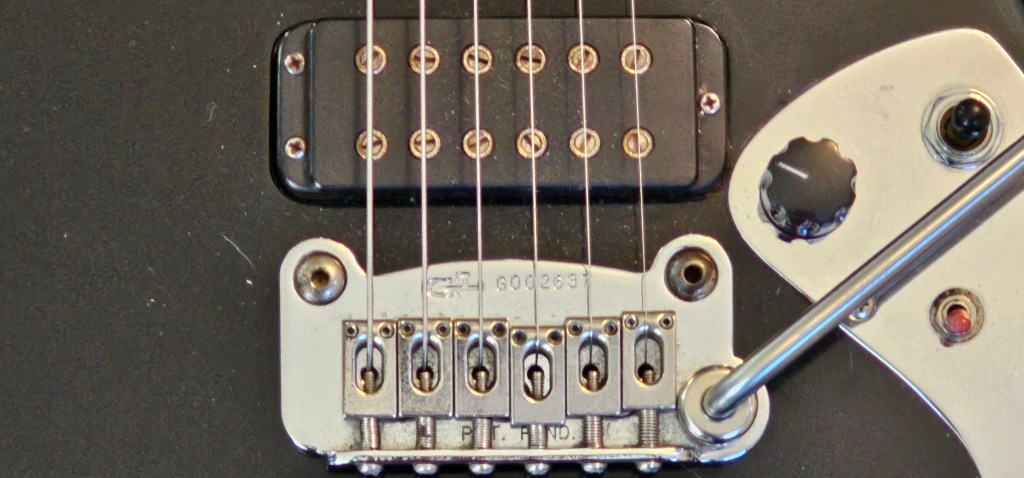
The 12 pole Magnetic Field Design humbuckers use ceramic magnets and threaded soft iron poles to shift the magnetic field to the top of the pickup and sound true to what was already Leo’s long-established aural aesthetic: bright, glassy, and full of punch.
The 3-way is a 3-way. The tiny black switch is a coil split; the red one is a phase switch (the F-100E was active; this is the passive version). There’s a master volume in the pickup adjacent strat position and a tone pot for eack pickup. All of that is mounted to a giant ancho chili shaped control plate. Leo, whose pickguard designs had been iconic to say the least, anticiped the later 80’s prestige guitar nakedness on what is also essentially the first super-strat. I’ve always seen that as a distinctive miss and have designed one. Maybe someday.
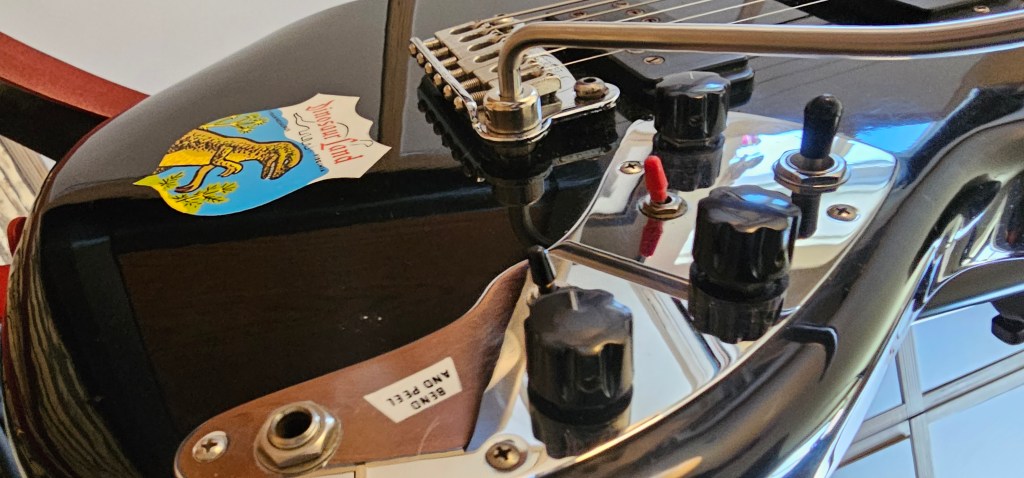
I’ve never come across one of the original volumptuously curved vibrato bars. I’d much prefer the curve and the Fenderesque plastic tip to the later G&L bar it came to me sporting, so please message if you happen to have one. Maybe I’ll make one up.
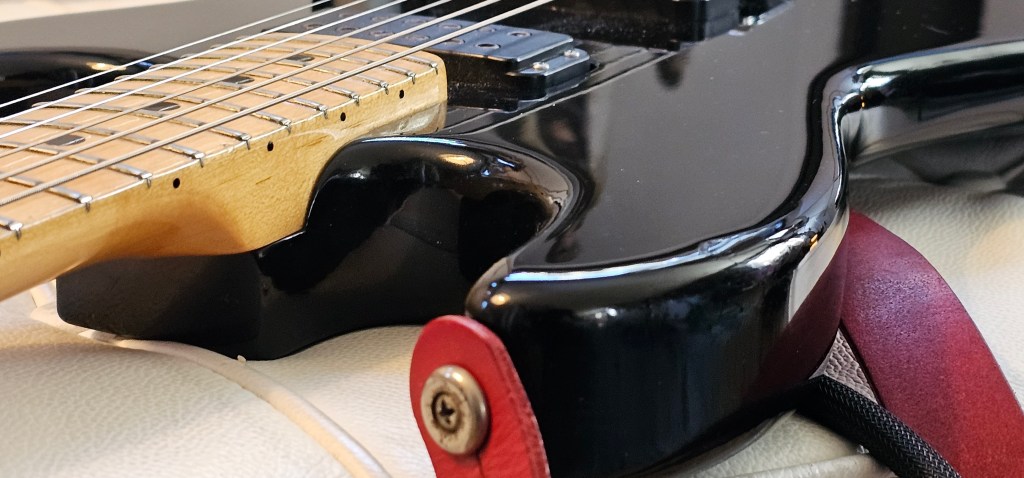
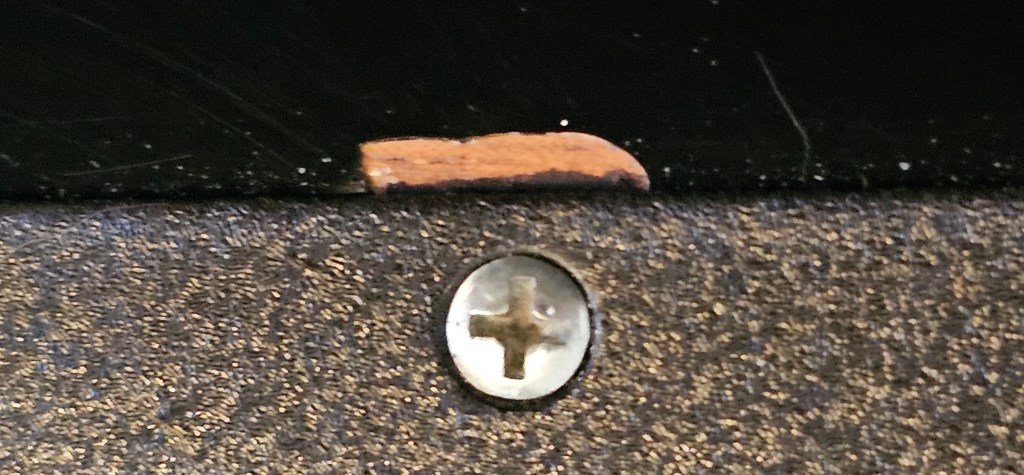
These guitars were built with one-piece maple necks on the mahogany bodies; the maple necks on the ash bodies had ebony boards.
The tuners are nicer than those used on Fenders after the sale to CBS. Similar, but they have nice tall posts and a more reliably constructed mechanism.

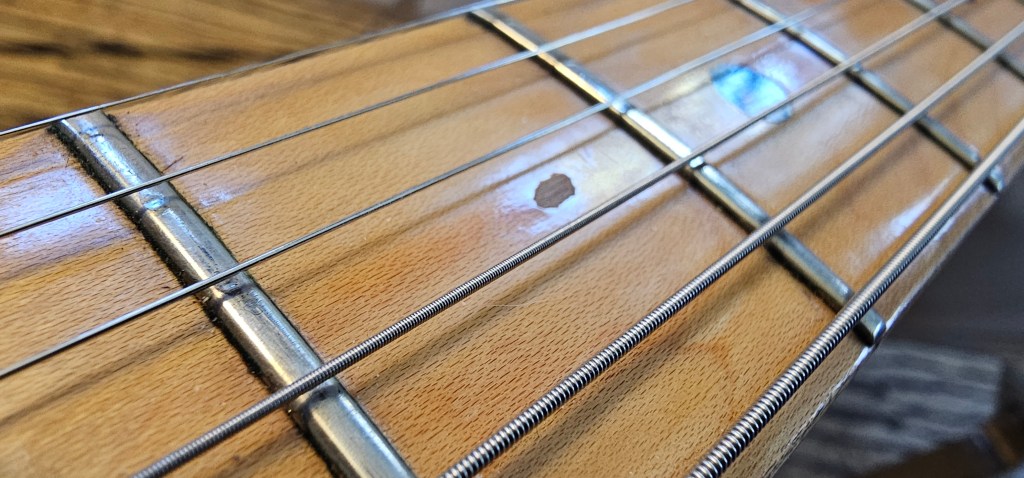
The neck on the Series IIs is absolutely classic Fender (Series Is had a 12″ radius). The fretwork is borrowed from Gibson.
For the first few years, these guitars were built with the assembly line precision of pre-CBS Fenders. They’re a deal.
 smithmusicroom